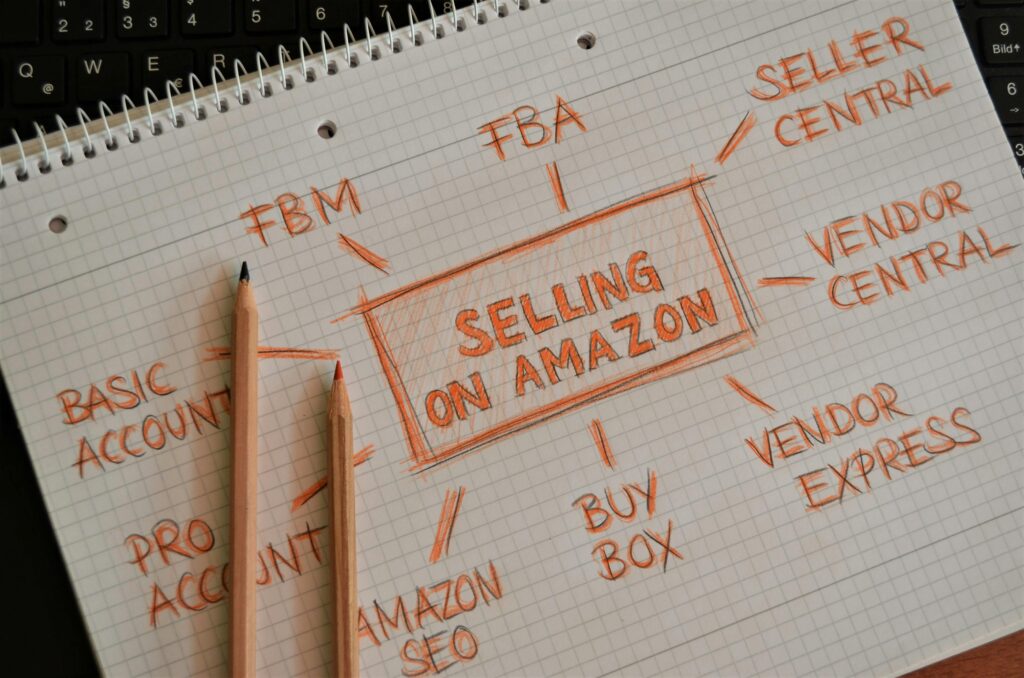
You can sell on Amazon without holding stock in five legitimate ways. Fulfillment by Amazon (FBA) moves inventory into Amazon’s warehouses, so you own it but never store or ship it. Dropshipping is allowed only if you are the seller of record and your supplier ships blind, under Amazon’s own policy. Print on demand through Merch on Demand prints a shirt or mug only after it sells. Kindle Direct Publishing (KDP) prints books to order and pays royalties. Amazon Associates and the Influencer Program pay commissions for sending buyers to products you never touch. Pick by capital and skill: FBA needs cash for stock, dropshipping needs a compliant supplier, print on demand and KDP need designs or writing, and affiliate work needs an audience. The rest of this guide covers fees, rules, and what breaks in practice.
Which inventory-free model fits you?
| Model | Upfront cash | You own stock? | Typical margin per sale | Main risk |
|---|---|---|---|---|
| FBA | $2,000 to $10,000 for a first order | Yes, in Amazon’s warehouse | 15 to 30% after fees | Unsold stock and storage fees |
| Dropshipping | Under $500 | No | 10 to 20% | Policy violations and slow shipping |
| Merch on Demand | $0 | No | Low single-digit dollars per shirt | Design rejection and tier limits |
| KDP | $0 plus editing and cover costs | No | 35 to 70% of eBook price | Discoverability |
| Associates / Influencer | $0 | No | 1 to 10% commission | No audience, no income |
How does FBA remove the inventory headache?
You buy the product, ship it to an Amazon fulfillment center, and Amazon stores, packs, ships, and handles returns. Your listing gets the Prime badge, which matters more than any other conversion factor on the platform. The official FBA overview describes the program and how to send inventory in.
FBA is inventory-light, not inventory-free. You still pay for the goods and for every cubic foot they occupy. Current charges on Amazon’s seller pricing page include a Professional plan at $39.99 a month, a referral fee of roughly 8 to 15% of each sale, a per-unit fulfillment fee of about $3 to $7 for standard-size items, and monthly storage that roughly triples from October through December. Since 2024 Amazon has also added inbound placement fees and a low-inventory-level fee, so sending in too little stock now costs money as well as too much.
What goes wrong: sellers order 1,000 units of an untested product, sell 200, and then pay aged-inventory surcharges after 181 days. Start with 100 to 300 units, confirm the listing converts, and only then reorder.
Is dropshipping on Amazon actually allowed?
Yes, with strict conditions. Amazon’s drop shipping policy requires that you are the seller of record, that your name appears on packing slips, invoices, and external packaging, and that no third-party supplier is identified anywhere in the shipment. You remain responsible for returns and customer service.
The policy explicitly bans the version most beginners try: buying from another retailer such as Walmart or AliExpress and having them ship directly to your Amazon customer. That earns account suspension, often after the first customer receives a package with another store’s receipt inside. Legitimate Amazon dropshipping means a wholesaler or manufacturer that agrees to blind-ship under your brand, usually with a signed agreement and a minimum monthly volume.
Beware of “Amazon automation” services that promise a done-for-you dropshipping store. The U.S. Federal Trade Commission has brought multiple cases since 2023 against operators who charged tens of thousands of dollars for stores that lost money or were suspended.
How does print on demand work on Amazon?
Amazon runs its own print-on-demand program, Merch on Demand. You upload a design, choose products such as t-shirts, hoodies, phone cases, and tote bags, and set a price. Amazon prints, ships, and pays a royalty after each sale. There is no fee to join, but you must apply and be accepted, and new accounts start in a tier with only 10 design slots. You move up by making sales.
Third-party services such as Printful and Printify also integrate with a standard seller account. These give more product variety and control over branding, but you pay the Professional plan fee and the referral fee on top of the print cost, and shipping times of 5 to 10 days hurt your ranking against Prime listings.
What goes wrong: trademark and copyright rejections. Any design that references a brand, a sports team, a song lyric, or a celebrity gets removed, and repeated strikes close the account. Original phrases and niche-specific art survive.
Can you sell books without printing them?
Kindle Direct Publishing is the cleanest inventory-free model Amazon offers. eBooks pay a 35% or 70% royalty depending on price and territory. Paperbacks and hardcovers are printed when ordered, and you receive roughly 60% of list price minus the printing cost. Low-content books such as journals and planners are still allowed but are heavily saturated, and KDP now requires you to disclose AI-generated text or images at upload.
How do you earn from Amazon with no products at all?
The Amazon Associates program pays a commission on qualifying purchases made within 24 hours of a click on your link. Rates are set per category in the commission income statement; most categories pay between 1 and 4.5%, with a few, such as luxury beauty, at 10%. You must make three qualifying sales within 180 days of signing up or the account is closed.
Two things changed since early 2024. First, the SiteStripe image and text-plus-image link tools were discontinued at the end of 2023, so older guides that tell you to grab product images through SiteStripe no longer apply. Second, the Amazon Influencer Program grew into the more valuable route for anyone with a social following. It gives you a storefront and lets your review videos appear directly on product pages, earning on-site commissions from shoppers you never sent to Amazon.
Every affiliate link and sponsored mention must be disclosed. The FTC Endorsement Guides require a clear disclosure near the link, not buried in a footer.
What does a production company see go wrong with Amazon video?
We shoot listing videos and Sponsored Brands video for sellers, and the same problems recur. Amazon rejects any video that shows a price, a promotion, a URL, a competitor, or a quoted customer review, and a single rejection can delay a launch by one to two weeks. Minimum resolution is 1280 by 720, but we deliver 4K because Amazon’s compression is severe.
A single-product listing video with a half-day shoot costs roughly $1,500 to $6,000 depending on location, talent, and how many cut-downs you need. For Influencer Program applicants, the blocker is usually the three-video approval step: Amazon wants the product in use, on camera, with honest pros and cons, not a slideshow. Vertical 9:16 for social and horizontal 16:9 for the product page should be planned as two framings on the same shoot day, not an afterthought in the edit.
What about Amazon Handmade?
Amazon Handmade is application-only and waives the Professional plan fee once you are approved, charging a flat 15% referral fee instead. It still requires you to make the goods, so it is inventory-free only if you make to order or send finished pieces to FBA. For most artisans, the honest trade-off against Etsy is higher traffic versus a higher fee and slower approval.
Which old advice should you ignore?
- Pre-orders as free funding. Seller Central does not offer pre-order listings to third-party sellers of general merchandise. The feature is limited mostly to media categories and vendor programs. Use Kickstarter or your own site if you need pre-launch cash.
- Selling consulting or services through Seller Central. Seller Central is for physical and media products. Amazon’s local services marketplace was wound down. Sell services elsewhere and use Amazon only for the products those services recommend.
- Subscription boxes. The Amazon Subscription Boxes program is invite-only and not a beginner path.
- The Amazon Appstore as a general app market. It serves Fire devices. Support for the Windows 11 Appstore ended in 2025, so it is not a route to a broad audience.
Start with the model that matches what you already have. If you have cash, run a small FBA test order of 100 to 300 units. If you have a blind-shipping supplier agreement, dropship under your own name. If you have designs or writing, upload to Merch on Demand or KDP this week. If you have an audience, apply to the Influencer Program and shoot the three review videos properly. Track fees against revenue every month, and reread Amazon’s policy pages before you scale, because the fee schedule and rules change every year.

