No network access was granted in this session (WebSearch, WebFetch and curl were all denied), so I could not verify URLs live. I have limited citations to stable institutional pages whose addresses I am confident in and dropped the ones I was not.
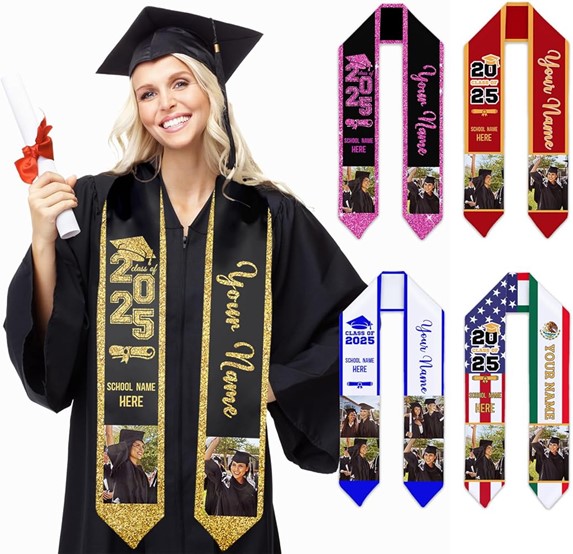
A high school stole is a satin sash, usually 60 to 72 inches long and about 5 inches wide, worn over the gown at graduation. Its significance is simple: it is the one piece of regalia that identifies the individual. The cap and gown say “graduate.” The stole says which graduate: honors, National Honor Society, a completed career-technical pathway, the Seal of Biliteracy, or a cultural heritage the student wants visible when they cross the stage. Schools award some stoles for verified achievement, and students buy others to mark identity. In a growing number of states the cultural kind is protected by law, which is the clearest sign of how much weight a strip of fabric now carries.
How a stole differs from a cord
Cords are twisted ropes worn around the neck, one color per honor, and a student may wear several. A stole is a single wide sash with room for embroidery, a crest or a flag, so most schools allow only one. Nearly all stoles sold today are polyester satin, not silk. That is why they cost tens of dollars rather than hundreds.
The Academic Costume Code maintained by the American Council on Education governs college regalia and defines hoods, not stoles. That gap is why high school stoles are so varied: every district writes its own rules.
Who awards stoles, and for what
About 87 percent of U.S. public high school students graduate within four years, according to the National Center for Education Statistics. The gown marks a near-universal milestone. The stole marks the exceptions.
- Academic honors. Honor roll, GPA thresholds set by the school, valedictorian and salutatorian.
- Organizations. The National Honor Society sells its own blue-and-gold stole. It means something only when the chapter adviser verifies membership, which most schools now do at the regalia check.
- Program completion. Career and technical education pathways funded under Perkins V, dual-enrollment college credit, and the Seal of Biliteracy, which nearly every state now awards for proficiency in two languages.
- Cultural heritage. Kente stoles woven in Ghana or printed in kente patterns, serape stoles for Latino graduates, flag stoles for first-generation immigrants, and lavender stoles tied to Lavender Graduation ceremonies for LGBTQ+ students.
- Athletics and custom. Team stoles and personalized ones with a name, year or quote.
Can a school stop you from wearing one?
For decorative or custom stoles, usually yes. Districts restrict regalia to keep the ceremony uniform and to avoid judging messages one by one. Cultural regalia is different. California’s Education Code section 35183.1, in force since 2018, gives students the right to wear traditional tribal regalia or recognized objects of religious or cultural significance at graduation. Montana, Washington, Oregon, Arizona and Oklahoma have passed similar protections, most of them aimed at Native students wearing eagle feathers and beadwork.
Read the district policy and your state law together. Get written approval in the spring, not an argument at the gate in June.
What stoles look like on camera
We film commencements, and in a wide shot of 400 identical gowns the stole is the only thing that distinguishes one graduate from the next. Three things go wrong. Glossy white and gold satin reflects stage light and blows out to a featureless patch, especially under afternoon sun on a football field. A matte or lightly textured satin reads better and costs the same.
Embroidered text under about an inch tall is unreadable from the back of a gymnasium at 1080p. A name or motto is for still photos, not the ceremony video. And unpinned stoles slide off one shoulder halfway down the aisle. A safety pin through the gown at each shoulder, hidden under the stole, fixes it.
At eight to ten seconds per name, a 400-student ceremony is more than an hour of walking. Parents scrubbing that footage find their graduate by stole color. A distinctive stole is practical, not vanity.
Cost, lead time and how to choose
| Stole type | Typical price | Lead time |
|---|---|---|
| Plain satin, stock color | $8 to $20 | 1 to 2 weeks |
| School crest or NHS stole | $20 to $40 | 2 to 4 weeks |
| Custom embroidered (name, flag, quote) | $25 to $60 | 3 to 6 weeks, longer in April and May |
| Hand-woven kente from Ghana | $40 to $150 | 6 to 8 weeks or more |
Prices drop sharply above about 50 units, which is why school-issued stoles are cheaper than the same design bought alone. Embroidery is priced per design and per stitch count, so a flag plus a name plus a year costs more than any one of them.
Choose in this order. Confirm what the school permits and what it will issue, so you do not buy a stole you cannot wear or already get. Pick one meaning for the stole and put the rest on cords. Order by early March for a May or June ceremony. Check the fabric under bright light before the day, and pin it.
If you are graduating this year, ask your counselor this week for the written regalia policy, note which stoles the school awards and the deadlines for earning them, and order anything you are buying yourself at least eight weeks before the ceremony.

