5 Employee Equipment Retrieval Services That End Offboarding Chaos
You’ve offboarded the employee and shuttered their accounts, yet the company laptop still languishes three states away.
That orphaned device is a live data grenade: 1 in 20 disappears during offboarding, Litespace’s 2023 survey of 300 IT leaders found, and each loss compounds replacement, breach, and audit costs.
The fix? Dedicated retrieval partners that ship padded kits, nudge ex-employees, certify NIST-level wipes, and log every hop.
Below, we break down five options—where they excel, where they stumble, and which one fits your risk, budget, and footprint.
How we chose these services
Before we recommend a vendor, we need a clear yardstick.
We started by asking the same questions you would fire off in an RFP: Will this partner get our gear back? Is the data safe? Can it reach every corner of the map without crushing the budget?
Then we translated those questions into six concrete filters:
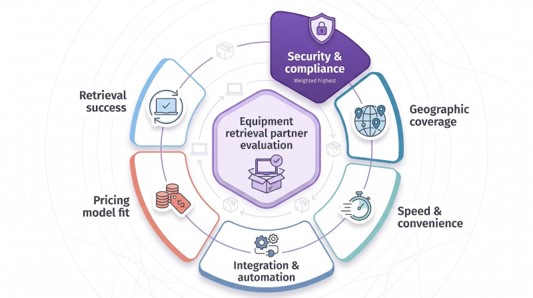
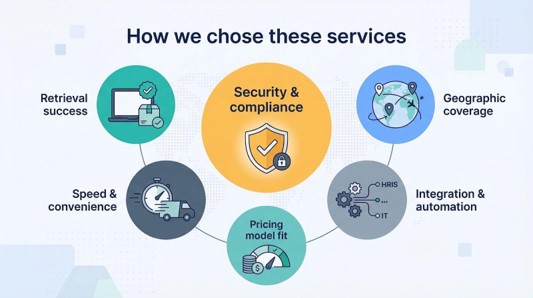
- Retrieval success. If a provider does not push past industry-standard return rates, it is out.
- Security and compliance. Certified NIST-level wipes, chain-of-custody logs, and audit-ready reports are non-negotiable.
- Geographic coverage. Remote teams span time zones, so the service must collect equipment wherever your employees live.
- Speed and convenience. Boxes, labels, and couriers should arrive fast, with tracking at every hop.
- Integration and automation. HRIS or ticket-system hooks keep offboarding from slipping through the cracks.
- Pricing model fit. Use a subscription when head-count churn is high; pay-per-use when turnover is light.
Every company in this guide cleared all six bars.
We weighted security the heaviest because a flawless pickup is worthless if the SSD is still readable. Geographic reach and pricing followed close behind. The result is not a beauty contest but a practical matrix that shows which partner solves which problem best.
In the sections that follow, you will see each service introduced where it naturally fits: white-glove lifecycle providers first, global-scale platforms next, pay-as-you-go disruptors after that, and finally the lean domestic option.
That order mirrors the way most teams evaluate their own needs, so you can read straight through or jump to the segment that matches your reality.
Allwhere: lifecycle logistics for mid-market teams
Picture a retrieval partner that behaves like an outsourced IT desk on fast-forward. That is Allwhere, which boasts a 91 percent on-time retrieval success rate, about 80 percent above the industry baseline, and ships padded kits, schedules the courier, and certifies each NIST-level wipe so your IT team never chases a box.
Founded in 2021 and, as of 2024, active in 23 countries across North America, Europe, and Latin America, Allwhere tackles a common pain for midsize companies: you have remote staff everywhere but not enough hands to chase boxes, wipe drives, and redeploy gear.
The workflow feels friction-free. HR marks an employee as terminated in Workday. Seconds later Allwhere pings the leaver, ships a padded return kit, schedules a courier, and adds a live tracker to your admin dashboard. When the laptop reaches a regional depot, technicians run a NIST-grade wipe and drop a PDF certificate into the portal. From there you choose to redeploy, store, or recycle the machine. One click, done.
Why does that matter? Because speed and completeness win the security game. The longer a device lingers, the higher the chance cached credentials escape. By automating every touchpoint—including timed reminders to the ex-employee—you compress the exposure window to days, not weeks.
Allwhere’s pay-as-you-go pricing is another plus. No monthly seat fees, no minimum volume. You pay only when you need a pickup, which keeps finance happy during slow turnover.
There are trade-offs. Coverage in Asia-Pacific remains patchy, so teams with a heavy APAC footprint may need a second vendor. User reviews also flag a clunky admin UI: functional but not as polished as the logistics engine.
Still, for organisations with roughly 100 to 5,000 employees concentrated in the US and EU, Allwhere offers white-glove service without a subscription leash. You regain control of the hardware life cycle and free your IT crew to handle work that moves the business forward, not boxes across state lines.
GroWrk: one partner, 150 countries, zero excuses
If your badge list reads like an airport board, GroWrk is built for you.
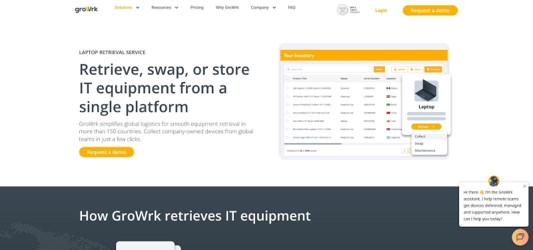
GroWrk global laptop retrieval platform screenshot
GroWrk global laptop retrieval platform UI screenshot
As of 2024 the platform operates depots and courier links in more than 150 countries, so a laptop in Nairobi rides a motorcycle to a nearby depot instead of limping through customs back to New York.
GroWrk sells predictability by subscription. For a flat per-employee fee, you unlock unlimited deployments, swap-outs, and pickups. Finance pins hardware logistics to one budget line, while IT never hesitates to request another kit.
The software is equally global. A single dashboard tracks every asset from purchase order to final wipe, complete with serial scans and chain-of-custody timestamps. Connect Workday or BambooHR, and terminations auto-trigger pickups so nothing slips through the cracks.
Security sits up front. GroWrk wipes each drive to NIST 800-88 standards and stores a destruction certificate alongside every shipping event. Large enterprises rely on those logs during SOC 2 and GDPR audits.
Trade-offs exist. During quiet hiring months you still pay the subscription, which can sting smaller teams. GroWrk also prefers to manage every geography under one contract, so mixing vendors may require tough negotiations.
For companies scattered across continents—and tired of “sorry, we don’t service that country”—GroWrk turns global sprawl into a single, reliable workflow.
Firstbase: flat-rate offboarding with a polished touch
Firstbase treats hardware the way Shopify treats e-commerce: a slick storefront for every employee backed by logistics you never see.
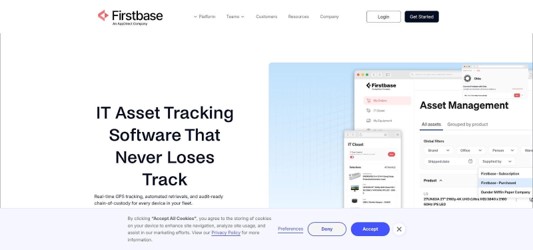
Firstbase IT asset recovery and retrieval portal screenshot
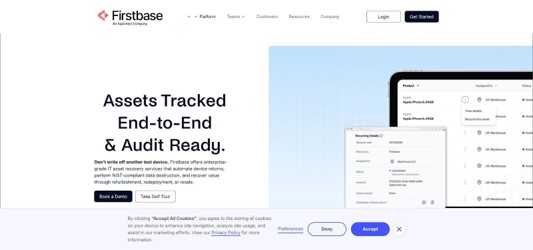
Firstbase IT asset recovery and retrieval platform screenshot
New hires pick their laptop and accessories from a branded catalog. When their stint ends, the same portal fires off a return label and clear instructions. As of 2024 the company reports a 97 percent retrieval rate, proof that speed plus clarity beat endless reminders.
Cost certainty is the hook. You pay one per-seat subscription that covers every shipment, swap, or pickup for the year. No calculations, no purchase orders, no waiting for finance to approve a one-off fee. For scale-ups juggling dozens of arrivals and departures each month, that simplicity saves time and debate.
Firstbase also slips into your tech stack without friction. Connect Rippling or BambooHR, and offboarding tasks spin up the moment HR changes a status. Tie it to your MDM, and the device can lock itself while the courier is still on the way.
There are caveats. A flat rate feels steep during hiring freezes; you keep paying even when boxes sit idle. Firstbase also prefers to act as your sole provider, so patchwork regional strategies may be off the table.
Still, if you want executive-level polish and a budget line that never surprises you, Firstbase delivers a hardware program your team can champion—so long as the head-count carousel keeps turning.
Quipteams: pay-as-you-go agility for unpredictable offboarding
Some months you offboard ten people, other months none. Locking into a subscription during that swing feels like buying an unlimited data plan for a landline.
Quipteams answers with straight pay-per-use pricing. No platform fees, no minimums. You pay about $80 to $150 per retrieval, tiered by country, and each charge covers the courier, the box, and a NIST-standard wipe.
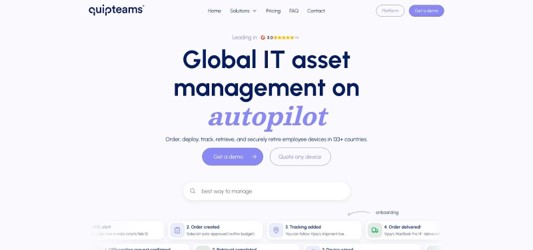
Quipteams pay-per-use laptop retrieval service dashboard screenshot
Quipteams pay-per-use laptop retrieval service screenshot
As of 2024 the service reaches more than 130 countries through local partners, so devices move across town rather than across borders. That keeps average return time between four and seven days, quick enough to redeploy hardware before the next hire signs.
Security steps fire in real time. Each hand-off scans into a chain-of-custody log, and wipe certificates land in your inbox the moment technicians finish. Connect Rippling or BambooHR, and the pickup request triggers automatically when HR closes an employment record.
Quipteams’ youth is its main caveat. Large layoffs of five-hundred-plus devices remain untested, and the team is smaller than the giants it competes with. If turnover is a constant flood, per-unit invoices can surpass a flat subscription.
For startups and midsize firms facing sporadic churn—or enterprises planning a single rightsizing event—Quipteams turns equipment retrieval into a predictable, budget-friendly line item instead of an ongoing commitment.
Retriever: no-frills pickups for US and Europe
Sometimes you just want the laptop back, no platform tour, no learning curve. Retriever stays in that lane.
Request a pickup, and a prepaid, tamper-proof box lands on the employee’s doorstep in one to two days. They drop the laptop inside, attach the included label, and hand it to UPS. When the box reaches Retriever’s depot, technicians scrub the drive and email you a wipe report. Job done.
Pricing is as plain as the workflow. Expect about $95 per device in core markets, with no contracts or recurring fees. That makes Retriever the budget safety net many HR teams keep on speed dial for one-off departures.
As of 2024 the service covers the United States, United Kingdom, and European Union. Outside those regions you will need another vendor, and Retriever is upfront about that boundary.
You also give up extras. No HRIS integrations, no storage or redeployment options, and bulk layoffs mean juggling a stack of tracking emails instead of a dashboard.
Still, for small businesses or occasional exits in the Western hemisphere, Retriever offers a fast, affordable, and compliant path to get hardware home without turning device ops into a project.
Quick-glance comparison
You now know each service’s personality. Before we pick a winner, here’s the cheat sheet you can send to finance or drop into an internal deck.
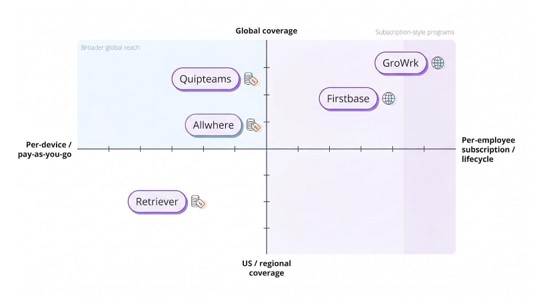
| Service | Reach (2024) | Pricing model | Stand-out strength | Watch-for |
| Allwhere | ~27 countries (North America, Europe, LATAM) | Pay-as-you-go | End-to-end lifecycle, easy redeploy | Limited APAC coverage |
| GroWrk | 150+ countries | Per-employee subscription | Global footprint, local depots | Subscription cost during slow turnover |
| Firstbase | 95 countries | Per-seat subscription | 97 percent retrieval rate, polished UX | Pricey in hiring freezes |
| Quipteams | 130+ countries | Per-device fee | No-commitment flexibility | Young company, cost creep at scale |
| Retriever | US / UK / EU | Per-device fee | Fast, low-cost pickups | No integrations, limited geography |
Use the table as a filter, not a verdict. Need one invoice worldwide? GroWrk is the obvious match. Care most about budget control? Quipteams or Retriever may suit you better.
How to pick the partner that fits your reality
Start with geography. If your organization plants pins in more than 30 countries, rule out any service that cannot match that footprint. GroWrk covers almost every flag on the conference-call dial, while Allwhere or Quipteams may be enough if your team clusters in the Americas and Europe.
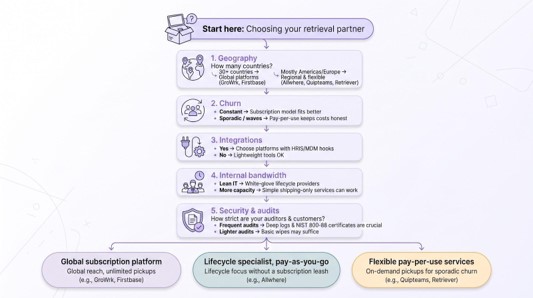
Next, count churn. High-growth or high-turnover businesses benefit from an unlimited subscription; the flat fee encourages every pickup, so devices do not slip through the cracks. If departures arrive in waves—or barely at all—on-demand pricing keeps the ledger honest.
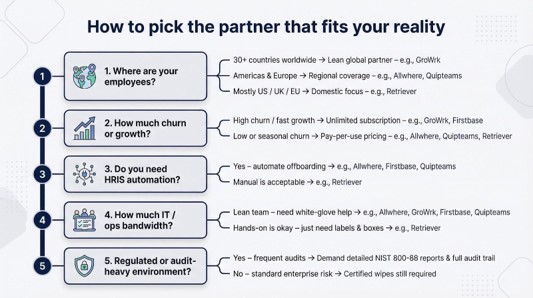
Look at integration muscle. Fully automated offboarding happens when your HRIS flips a status and the retrieval request fires without human clicks. Allwhere, Firstbase, and Quipteams already plug into popular HR systems; Retriever leaves that work to you.
Then weigh internal bandwidth. A lean IT crew gains from white-glove providers that handle employee emails, packaging, and storage. If you prefer hands-on control and only need a shipping label, a lightweight choice like Retriever is painless.
Finally, stress-test security posture. Every vendor promises a certified wipe, but ask to see a sample certificate and the audit trail behind it. If regulators or customers audit you regularly, the depth of that paperwork will matter more than a flashy dashboard.
Frequently asked questions
What if an ex-employee ignores every reminder?
Most services keep nudging for you, yet you still hold the legal reins. In many U.S. states you cannot dock final pay, so companies escalate by disabling the device through MDM and, if the gear never resurfaces, filing a theft report. Retrieval partners supply the shipping evidence you need for that paperwork.
How fast will we see the device back in our inventory?
Domestic pickups usually close within about five business days. International returns take four to fourteen days, depending on whether the provider keeps shipments inside national borders or routes them through a central hub.
Do these vendors wipe data, or is that still on us?
Every service in this guide performs a NIST 800-88 wipe after receipt and issues a destruction certificate. Treat that as a second layer; you should still remote-lock the laptop the moment offboarding starts.
Can they handle monitors, phones, or peripherals?
Yes. Boxes come in multiple sizes, and you flag extra items when you book the pickup. Larger or fragile gear may cost more to ship, but it stays within the same workflow.
Is a retrieval partner worth the money for just a few devices a year?
Run the numbers: losing one laptop can expose you to roughly $50,000 in breach forensics, IP risk, and replacement cost. Paying under $150 for a certified, trackable pickup protects both budget and data.
Conclusion
Run those five checkpoints, and the right partner usually reveals itself. The goal is not to chase the flashiest feature list; it is to guarantee that the next time someone exits, their laptop comes home without drama.

