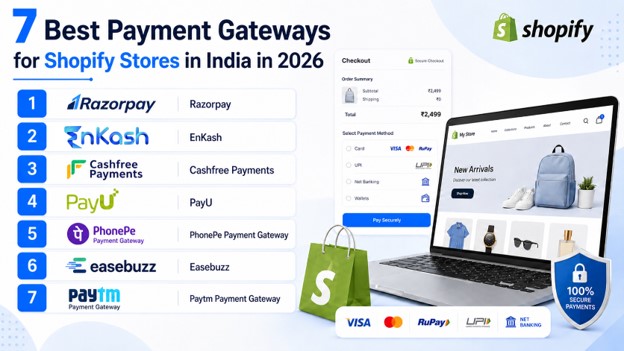
For most Indian Shopify stores, start with Razorpay or Cashfree Payments. Razorpay is the safest all-round choice. Cashfree is better if cash-on-delivery (COD) is a large share of your orders. PayU suits higher-ticket stores that need EMI and offers. PhonePe PG suits mobile, UPI-heavy audiences. Easebuzz is a simple option for small businesses. Cashfree and EnKash are worth a look when fast settlement matters more than the checkout itself. Paytm PG works, but some of its wallet features have shrunk since 2024. Shopify Payments isn’t offered in India, so every store here uses a third-party gateway. The real cost is the gateway fee, plus 18% GST on that fee, plus any Shopify transaction fee your plan charges.
How do the seven compare?
| Gateway | Best for | Shopify integration | Pricing (verify at onboarding) |
|---|---|---|---|
| Razorpay | Most D2C brands, default choice | Dedicated app | 2% standard; higher for Amex, Diners, international and EMI |
| Cashfree Payments | COD-heavy stores, conversion tools | Payments plugin plus a direct-card plugin | Custom quotes |
| PayU | Higher order values, EMI and offers | Dedicated app, refunds from inside Shopify | The 1.9% Shopify promotion closed on 30 June 2026; ask for current rates |
| PhonePe PG | Mobile, UPI-first audiences | Plugin | Promotional zero platform fee against a listed 1.99%; check eligibility |
| Easebuzz | Small businesses that want a simple setup | App/plugin | Custom quotes; T+1 settlement is standard |
| EnKash | Teams focused on settlement and reconciliation | Plugin, APIs, SDKs | No setup fee; custom transaction rates |
| Paytm PG | Customers already using the Paytm app | Dedicated integration | Rate varies by payment method; zero on UPI and RuPay debit |
What does a gateway actually cost per order?
Take a ₹1,000 order at a 2% gateway fee. The fee is ₹20, and GST at 18% on that fee adds ₹3.60, so you lose ₹23.60 before Shopify charges anything. Shopify may add its own fee on third-party payments depending on your plan. Check the transaction-fee line for your plan on Shopify India’s pricing page rather than assuming it’s zero.
Since 2020, banks and payment companies have not been allowed to charge a merchant discount rate (MDR) on UPI and RuPay debit card payments. Gateways still charge a “platform fee” on those payments, which is why rate cards differ so much. Paytm lists UPI at zero. Razorpay’s published pricing applies its standard rate unless you negotiate. Once a store processes a few lakh rupees a month, every provider will negotiate, so get quotes from at least two.
Gateway pricing on UPI is under pressure. UPI now handles most Indian digital payments by volume (see NPCI’s monthly UPI statistics). If your orders are mostly UPI, you are paying for reliability and tooling, not for payment rails, so negotiate on that basis.
Which gateway fits which store?
- Razorpay. It has the most mature Shopify app, covers UPI, cards, net banking, wallets, EMI and Pay Later, and offers add-ons like Magic Checkout and Instant Settlement (extra cost). Pick it if you don’t have a specific reason to choose another.
- Cashfree. Its edge is the tooling around COD: verifying COD orders, nudging COD buyers to pay upfront, and one-click checkout. COD orders that are refused or never delivered come back as returns (RTO), and that loss usually costs more than any gap in gateway fees.
- PayU. Card payments can happen on your site instead of a redirect, an affordability widget shows EMI options, offers can be tied to specific products, and refunds can be issued from Shopify. All of this matters most above roughly ₹3,000 per order.
- PhonePe PG. It’s strong on UPI, detects downtime on payment methods, and has short checkout flows. Ask how long the zero-fee promotion lasts and what the rate becomes afterwards.
- Easebuzz. It’s a quick, plugin-based setup that covers the usual Indian payment methods. Good for small stores that don’t need extras.
- EnKash. It’s an RBI-authorised payment aggregator. Its pitch is instant or custom settlement schedules (including weekends), reconciliation and finance reporting, rather than checkout features.
- Paytm PG. T+1 settlement by default, same-day settlement on request.
What changed since early 2026?
- PayU’s 1.9% Shopify offer has ended. It required onboarding by 30 June 2026. Any rate you see quoted from it is out of date.
- Paytm Wallet and Postpaid matter less. RBI stopped new deposits and top-ups at Paytm Payments Bank from March 2024, so customers can no longer add money to their wallets. Paytm also cut back Postpaid. Treat them as minor payment options, not a reason to choose Paytm.
- Licensing matters more. Under RBI’s payment aggregator guidelines, any gateway holding merchant funds needs authorisation. Check that your provider is on RBI’s list of authorised operators before signing.
What goes wrong in practice?
We make performance video and run launch campaigns for D2C brands, and the gateway problems we see show up in ad results, not in fee tables. The common one is a sale-day spike that coincides with a bank or UPI app outage. Paid traffic reaches checkout, payments fail, and that ad spend is wasted. Gateways that automatically retry or reroute through a different bank recover some of those orders. Ask each provider how they handle a specific bank going down. A general reliability promise doesn’t answer that.
The second problem is COD. Many Indian categories see RTO rates of 20–30% or more on COD orders, depending on category and region. Each one costs two-way shipping and leaves stock unavailable for weeks. A gateway that converts even a small share of COD orders to prepaid usually saves more than a 0.2% fee difference.
The third is reconciliation. Once a store passes a few hundred orders a day, finance has to match each Shopify order to its payment, fee, refund, settlement and bank credit. Gateways that put the Shopify order ID in their settlement reports save days at month-end.
What should you check before signing?
- That the provider is listed for India in Shopify’s third-party provider directory. (Shopify Payments isn’t available in India.)
- The fee for each payment method in writing, including Amex, international cards and EMI, and what the rate becomes after any promotion ends.
- The standard settlement cycle, the cost of faster settlement, and whether settlement runs on weekends.
- Whether partial refunds can be issued from inside Shopify, and how long they take to reach the customer.
- Payment success rates by method, how they handle downtime, and who you can reach during a live sale.
Next step: open your Shopify analytics and pull your payment mix (UPI, cards and COD as shares of orders) and your average order value. Use that mix to get written quotes from Razorpay plus the specialist that fits your biggest problem. That’s Cashfree for COD, PayU for high order values, PhonePe for UPI and EnKash for settlement. Then put a real order through each gateway in test mode: pay, partially refund, and trace it to the settlement report before going live.

