How Custom Flags Boost Brand Visibility at Events
Events give businesses a chance to meet customers face to face. They also create a crowded marketing environment. Trade shows, outdoor promotions, product launches, and community events often feature dozens of competing brands. To attract attention, businesses need visual assets that communicate their identity quickly.
Custom flags offer a practical solution. They add height to event displays, improve visibility from a distance, and help visitors locate a brand in a busy venue. When designed and positioned correctly, they become a functional part of an event's marketing strategy.
Why Flags Work in Event Marketing
Flags use large graphic areas and vertical placement to make brand messages easier to spot. Unlike small brochures or tabletop signs, they can remain visible above parts of a crowd or other display elements. Their movement can also draw attention in outdoor settings.
Placement matters as much as appearance. A flag near an entrance can establish a visual landmark. One beside a booth can identify the business from an approaching aisle. At an outdoor activation, flags can define the perimeter and guide visitors toward demonstrations or registration points.
The objective is not simply to display a logo. It is to make the brand easier to recognize and the event easier to navigate.
Choosing the Right Flag for Your Brand
Flag selection should start with the venue, viewing distance, and intended use. Businesses planning an event can explore custom made flags to find options that support their display requirements and branding goals.
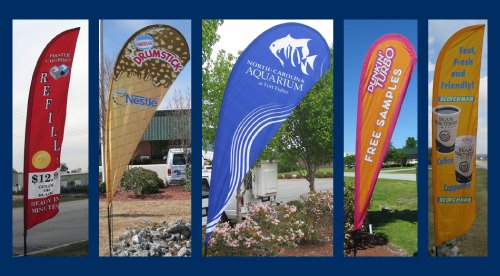
Different formats serve different purposes. Feather flags work well along walkways and outdoor entrances because their narrow, vertical shape uses limited ground space. Teardrop flags offer a compact graphic area and can suit entrances, promotional stations, and smaller displays. Rectangular flags provide a familiar format for logos, short messages, and corporate colors.
Consider these factors before ordering:
- Viewing distance: Use larger graphics and fewer words when visitors will see the flag from across a venue.
- Installation space: Check ceiling clearance, aisle width, base dimensions, and restrictions on ground stakes.
- Environmental conditions: Select fabric, stitching, and mounting hardware appropriate for expected wind and weather exposure.
- Portability: Lightweight poles and compact bases are useful for teams that attend multiple events.
- Brand consistency: Match logo proportions, approved colors, and typography to existing marketing materials.
These specifications affect both visibility and practical performance. A flag that looks good in a product mockup may be difficult to read from a distance or unsuitable for the intended installation area.
Design Flags for Fast Recognition
Event visitors rarely stop to study every display. Flag graphics should communicate the brand with minimal effort. A clear logo, strong contrast, and a restrained color palette usually perform better than a layout crowded with product details.
Use a visual hierarchy. The logo or primary brand identifier should be the first element people notice. A short supporting phrase can explain the offer or category if the viewing distance allows it. Contact details, lengthy descriptions, and multiple calls to action often become unreadable on a moving or distant display.
Contrast is especially important. A dark logo on a light background, or the reverse, can improve legibility when the colors remain consistent with the brand identity. Avoid placing important text near curved edges, seams, or areas that may fold around the pole.
Position Flags to Support Visitor Movement
Good placement connects visibility with visitor behavior. Start by identifying the main approach routes, entrances, registration desks, and high-value activity areas. Position flags where they can be seen without blocking signs, emergency exits, accessible routes, or neighboring exhibitors.
For a trade show, a flag can identify a booth from the aisle while the main display communicates product details at closer range. At an outdoor event, a series of flags can mark a route from the entrance to a demonstration area. Repeated brand colors and consistent spacing can create a recognizable visual path.
Measure Whether Flags Improve Results
Visibility is useful, but it should support a measurable marketing objective. Establish a baseline and decide what success means before the event begins. Depending on the campaign, relevant indicators may include booth visits, qualified leads, product demonstrations, QR-code scans, or registrations.
Use a dedicated landing page or campaign-specific QR code if you want to connect event exposure with digital activity. Compare results across events while accounting for differences in attendance, location, staffing, and promotional offers. Visitor counts alone do not establish that a flag caused an increase in engagement.
For broader campaign measurement, the Federal Trade Commission's advertising and marketing guidance provides a useful reference for keeping promotional claims truthful and evidence-based.
Make Flags Part of a Consistent Brand System
Custom flags work best alongside coordinated signage, booth graphics, staff apparel, and digital content. Consistency helps visitors connect the physical display with the brand they encounter online or after the event. It also creates a stronger visual setting for event photography and video.
Plan storage, cleaning, and transport as part of the campaign. Inspect fabric, seams, poles, and bases before each use. Follow the supplier's care instructions and replace damaged components before they affect the display.
A well-designed flag cannot compensate for an unclear offer or a poorly managed event. It can, however, make a business easier to find, recognize, and approach. With the right specifications, placement, and measurement plan, flags become a practical tool for improving event visibility and supporting wider marketing goals.

